Showing posts with label golden fluid acrylics. Show all posts

Thursday, February 28, 2013

4 Paws Facing Southwest - 5″ x 5″ – Painting Stages

“Experience is not what happens to a man. It is what a man does with what happens to him.”
Aldous Huxley

Copyright Beth Parker Art 2013

Copyright Beth Parker Art 2013

4 Paws Facing Southwest -  5″ x 5″  – Painting Stages

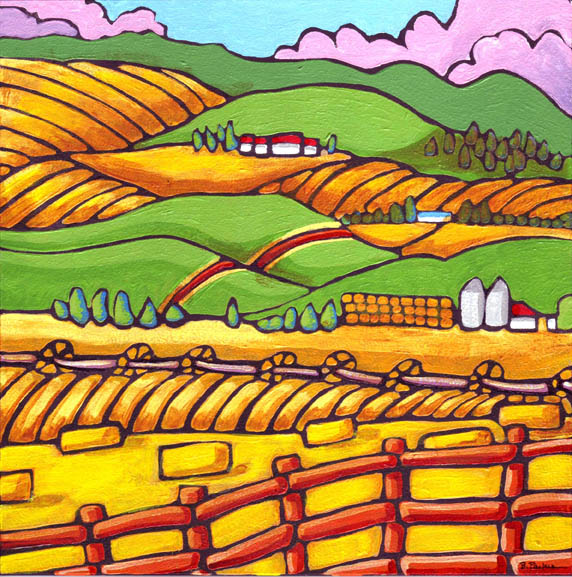
I painted this little painting from the driveway of the cabin I stayed in during my 2011 Driggs, Idaho visit.  It’s 5″ x 5″ and I’ve included the progress shots of the stages.  First, I took a panel that I had painted earlier with black gesso.  I drew the lines on with chalk that I wanted to stay black.  Then, with Golden Fluid Acrylic, I painted the underpainting.  I come in and add color after that.  Layers and layers and layers of glazing (with Golden Fluid Acrylic) later, I end up with the finished painting.  These little acrylics are better in person.  :)

About Aldous Huxley

Aldous Huxley, the cerebral English writer and social critic, is best known for his dystopian novel Brave New World, about a theoretically ideal society that stamps out individuality. He was born in Surrey on July 26, 1894. His teen years were difficult: His mother and sister died when he was 14 and a few years later, he became nearly blind. After early success with fiction, he switched to essays and screenplays, moving to California and becoming a kind of guru for the 60′s counterculture movement. He died on November 22, 1963.

Tuesday, February 12, 2013

4 Paws West View – 8″ x 8″ Acrylic on Panel

Change and growth take place when a person has risked himself and dares to become involved with experimenting with his own life.
Herbert Otto

Copyright Beth Parker Art 2013

4 Paws West View – 8″ x 8″ Acrylic on Panel

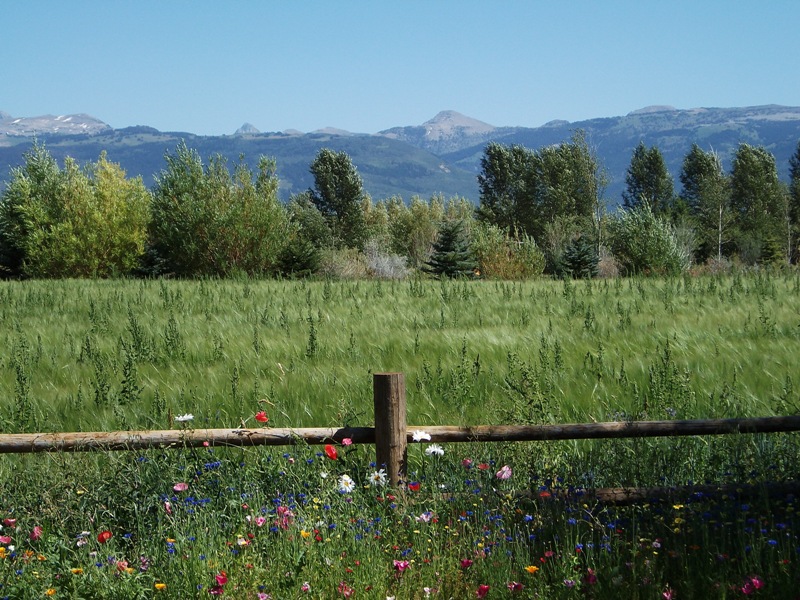
Since I have Idaho on my mind, I thought I would share another painting from my Driggs visit in 2011.  I painted this while I was there at the 4 Paws cabin.  It’s my interpretation of the view to the west of the cabin.   I am so excited that I’m spending time in Driggs this summer, especially since it will probably be 110 degrees here in Oklahoma.  During their heat wave in August of 2011… it was 90.  :D

I really love that quote by Herbert Otto, but I couldn’t determine what Herbert Otto to credit this quote to.  Yes!  There was more than one Herbert Otto when I googled him.  Who knew?

Wednesday, April 11, 2012

Rolling Fields of Memory - Acrylic on Gallery Wrapped Canvas 24″ x 36″

“Each new season grows from the leftovers from the past. That is the essence of change, and change is the basic law.”
–Hal Borland

Copyright Beth Parker Art 2012

Tah-Dah!  -  Rolling Fields of Memory
Acrylic on Gallery Wrapped Canvas  24″ x 36″

Or…. the back yard at Bethville.  *giggle*  It is actually my memories of the Eastern Idaho landscapes I visited last summer.

Sorry for the bad photo.  The florescent light in my lobby is working only part time, so I took this with a little light coming through the window, over-lighting the left panel.  The lines match up when the paintings are pushed together, but for some reason, I didn’t do that for this photo.  I’ll get some better pictures later, but I wanted to show you the finished painting.   As soon as I varnish it, it’s going to Our Favorite Place.  They have a spot saved for it.  :)

My next one is going to be a single painting, 24″ x 48″.    Weeeee!  This is fun!

Hal Borland wrote what he liked to think of as his “outdoor editorials” for the Sunday New York Times from 1941 until just before his death in 1978. Born on May 14, 1900, on the prairie in Nebraska, he grew up in Colorado, and then moved to New England in 1945. Borland brought to his writing both personal life experience with nature and the wisdom and ways of rural America.

Edwin Way Teale said the Mr. Borland’s “books are always like a breath of fresh country air.” Like his Sunday editorials, his outdoor books are essays which follow the seasons through the year: An American Year, Hill Country Harvest,Sundial of the Seasons, Seasons, Hal Borland’s Book of Days, Hal Borland’s Twelve Moons of the Year. Trained as a journalist, his writings report the daily news from the world of nature.

Mr. Borland also wrote four novels that include theme of nature and human’s relationship with nature. His most famous fiction is When Legends Die. The novel tells the story of Tom, a Ute Indian boy who is raised in the wilderness by his parents. They die when he is still young, so he adopts the old Ute ways, builds a lodge for himself, and lives off the land. However, neither the Utes nor the whites will leave him alone. Men from both communities use him for their own gain. Finally he returns to the mountains where he rediscovers himself and his roots. Other novels he wrote are The Amulet, The Seventh Winter, and King of Squaw Mountain.

Mr. Borland and his wife, Barbara, lived on a 100 acre farm, the site of an old Indian village in northwestern Connecticut. Mrs. Borland was also a writer and assisted her husband in his writing, too. Mr. Borland wrote many magazine articles, poems, essays, and stories as well as his many books.

Tuesday, April 10, 2012

Gallery Wrapped Canvas Edges

“There are two ways of exerting one’s strength: one is pushing down, the other is pulling up.”
– Booker T. Washington

Copyright Beth Parker Art 2012

Gallery Wrapped Canvas Edges – A Sneak Peek

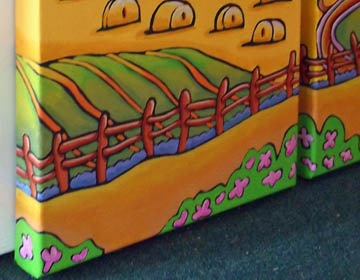
Well, I think it’s finished.  All I have to do now is sign it and varnish it.  I wanted to show you how I painted around the edges.  All four sides on all three panels are continued around the edges.  The gallery will sell them as individual paintings or all together, so each one needed to be a complete piece of art.  I am so excited to be done, but at the same time… I’m going to miss it.  This baby has been a big part of my life for over 3 weeks.  I guess that means it’s time to start another.  **giggle**

About Booker T. Washington

Booker T. Washington, the influential American educator, was the first African-American to be invited to the White House; he also had tea with Queen Victoria. He was born in slavery in Virginia in 1856. After emancipation, he worked in the salt mines. When he learned of a school that would accept former slaves, he walked much of the 400 miles to get there. He became an outspoken advocate of education and hard work for African-Americans and founded Tuskegee University. He died in 1915.

Monday, April 9, 2012

A New Sneak Peek at new Painting

“You are invited to live more consciously, to get off auto pilot and cruise control. To try new things to find out who you really are in this moment and time.”
– James Hollis, Ph.D.

Copyright Beth Parker Art 2012

Another Sneak Peek at new Painting

I have been working on this every morning and more on the weekends.  It is such a slow process, as I tweak this and fine tune that.  I am so very pleased with this painting.  I have a growing affection for the whole process.  It’s a shame I have to keep going to my day job.  I could happily create in my studio all day.

This is the same little peek I showed you here.  It’s a wee little part of what I showed you here.   It’s on the far left panel, in the top third.  Many layers of color and glaze have been added since then.  I am almost finished.  A little more tweaking and fine tuning to go.  I think I even have the title… Fields of Memories, or something along that line.   Are two plurals in a title improper?  Like I said… or something like that.  :)

James Hollis, Ph.D., was born in Springfield, Illinois. He graduated with an A.B. from Manchester College in 1962 and with a Ph.D. from Drew University in 1967. He taught the Humanities 26 years in various colleges and universities before retraining as a Jungian analyst at the Jung Institute of Zurich, Switzerland (1977-82). He is a licensed Jungian analyst in private practice in Houston, Texas, where he served as Executive Director of the Jung Educational Center of Houston from 1997-2008. He lives with his wife Jill, an artist and therapist, and together they have three living children, and six grand-children. He is a retired Senior Training Analyst for the Inter-Regional Society of Jungian Analysts, was the first Director of Training of the Philadelphia Jung Institute, and is vice president emeritus of the Philemon Foundation, which is dedicated to the publication of the complete works of Jung. Additionally, he is Director of the Jungian Studies program of Saybrook Graduate School of San Francisco.  (See www.saybrook.edu, and then Jungian Studies).

He has written eight books published by Inner City Books, a Jungian-oriented press located in Toronto, Canada; he has also written three books published by Gotham Press, a division of Penguin, and two books published by academic presses. His books have already been translated into Russian, German, Swedish, Spanish, Portuguese, Turkish, Italian, Korean, Finnish, Hungarian, French, Czech, and Japanese.

Monday, April 2, 2012

3″ Crop from Panel 3 – Still adding color

“We may spend our lives seeking something that is right inside us, and could be found if we only stop and deepen our attention.”
–Tara Brach

Copyright Beth Parker Art 2012

Itty Bitty 3″ Crop from Panel 3 – Still adding color

The color is starting to be defined and the fun is really beginning.  This part is so addictive!  I just keep adding more layers and more light and shadow.  It’s so hard to walk away at this point.  I got to paint most of the day, yesterday.  I still have so much to do.

My non artist hubby is having a hard time reconciling all the time it takes to do these.  He sees all the hours as less and less profit when it sells.  I tried to explain to him that it’s not really about the money, but as his eyes glazed over, I explained that I will always own the image itself and I can reproduce it in other ways to make more money.  That seemed to satisfy him, sorta.   It makes little sense to the non artist that we fall a little in love with the “whole” of the painting as we tenderly dab on each little bit of color, delighting in each new shadow or area of light that dances off the canvas.  I can’t wait to see it hanging on the gallery wall and I hope that someday, someone will love it as much as I do.

Tara Brach is a leading western teacher of Buddhist meditation, emotional healing and spiritual awakening. She has practiced and taught meditation for over 35 years, with an emphasis on vipassana (mindfulness or insight) meditation. Tara is the senior teacher and founder of the Insight Meditation Community of Washington. A clinical psychologist, Tara is the author of
Radical Acceptance: Embracing Your Life With the Heart of a Buddha and the upcoming book, True Refuge-Three Gateways to a Fearless Heart (Bantam, February 2013).
Tara is nationally known for her skill in weaving western psychological wisdom with a range of meditative practices. Her approach emphasizes compassion for oneself and others, mindful presence and the direct realization and embodiment of natural awareness.

Friday, March 30, 2012

Sneak Peek at Underpainting

“I searched through rebellion, drugs, diet, mysticism, religion, intellectualism, and much more, only to find that truth is basically simple and feels good, clear and right.”
– Armando “Chick” Corea

Copyright Beth Parker Art 2012

Another Sneak Peek at Underpainting

Sorry this is so blurry.  It does give a little glimpse into how I add color. I have to remember where color moves from one canvas to the next.  Each canvas has it’s own composition, but all three together are really FUN!

I was kinda hoping it would rain all weekend, so I could paint, but I imagine the boat will get it’s 2012 maiden cruise.  The last two summers were so hot that we barely used it.  Since we have 80′s in March, it may be that way again this summer.  But, while we are hanging out on the lake, soaking up rays, I’ll be writing my artist bio.  I have to do it for the gallery and I’m not very good at talking about myself.  Wish me luck!  :)

About Armando “Chick” Corea

Armando “Chick” Corea, the American jazz pianist best known for his composition “Spain,” epitomizes experimentation in jazz, incorporating sounds from classical, rock, and flamenco traditions. He was born in 1941 in Massachusetts. Son of a jazz trumpeter, he began playing piano at age four. He dropped out of Julliard to learn by doing. He played on the seminal Miles Davis Bitches Brew recording, and formed his own jazz fusion group in the early 1970′s. He founded his own record label in 1992.

Thursday, March 29, 2012

Underpainting the Colors

“I have learned, as a rule of thumb, never to ask whether you can do something. Say, instead, that you are doing it. Then fasten your seat belt. The most remarkable things follow.”
– Julia Cameron

Copyright Beth Parker Art 2012

Little Bit of Underpainting

I have been getting up before 5:00 am to go paint in the studio before work.  I’m slowly adding color.  These colors you see are still part of the underpainting, because there will be many layers of color and glazing.  Maybe it’ll give you an idea how these paintings develop.   It’s slow, but fun!   :)

About Julia Cameron

American author Julia Cameron has become an icon in the creative community for her best-selling self-help book, The Artist’s Way, which guides people through a series of simple but profound exercises to awaken their creativity. She grew up in Chicago and has been writing seriously since age 18. In addition to her 28 books, she has written plays, screenplays, and songs. She was married to film director Martin Scorsese and has one daughter. She currently lives in New York.

Wednesday, March 28, 2012

Underpainting to the Chalk Lines

“Habits of thinking need not be forever. One of the most significant findings in psychology in the last twenty years is that individuals can choose the way they think,”
–Martin Seligman

Copyright Beth Parker Art 2012

Underpainting my new Tryptic – Three 12″ x 24″ Gallery Wrapped Canvases

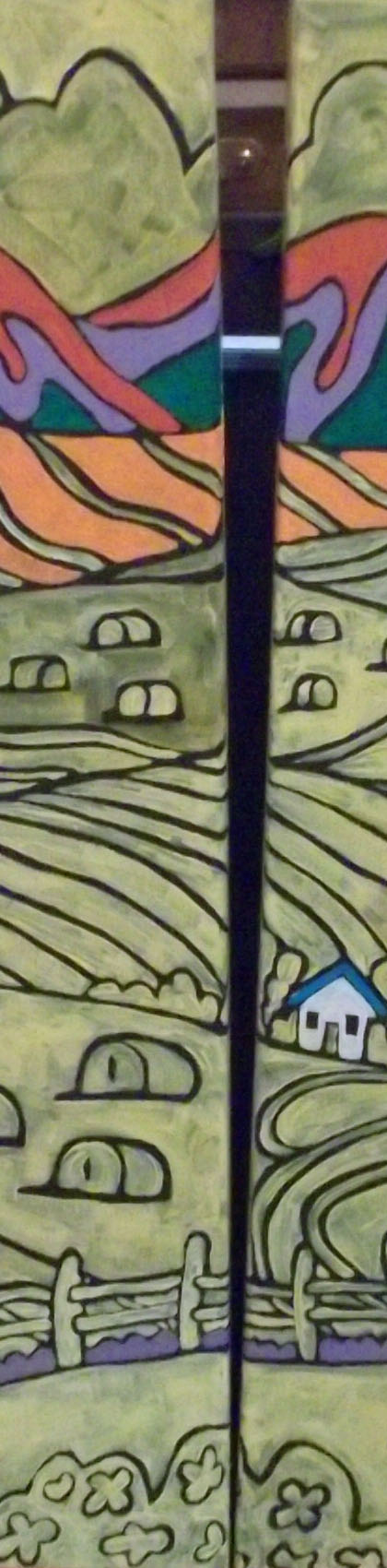
After I draw the chalk lines, I lay down an underpainting, using Golden Fluid Acrylics.  I paint right up to, but not over, all the chalk lines.  After the entire underpainting is dry, I wipe all the chalk lines off with a damp cloth.  That gives me the black outlines.  This stage is a little tedious, but it’s really fun to watch it develop.  :)

Yesterday, I took 12 paintings over to Our Favorite Place, Eufaula’s new gallery.  It is so exciting!  They are planning a soft opening on April 9th.  No party or anything, just yet.  I think she wants to work all the bugs out first.  The owner of the gallery, Karen Weldin, doesn’t know anything about owning a gallery and she is not an artist.  She has pulled together an awesome committee of artists and people experienced with running a gallery, to help her put her dream in motion.  She bought the building last year and knew it was meant for something special.  (She’s right!)  The 100 year old building has been undergoing a complete restoration, bringing it back to it’s former glory.  There are some photos on their website and I’ll take more when all the art is hung.

Authentic Happiness is the homepage of Dr. Martin Seligman, Director of the Positive Psychology Center at the University of Pennsylvania and founder of positive psychology, a branch of psychology which focuses on the empirical study of such things as positive emotions, strengths-based character, and healthy institutions.
This website has more than 2 million users from around the world, and you are welcome to use all of the resources available here for free.  The best place to start is by learning more about the latest theory and initiatives in positive psychology, by taking one of our well-being questionnaires, or by checking out recent presentations and selected media.

Friday, November 18, 2011

Small Bit of Large Painting – Acrylic on Canvas

“We must have courage to bet on our ideas, to take the calculated risk, and to act. Everyday living requires courage if life is to be effective and bring happiness.”
–Maxwell Maltz


Small Bit of Large Painting – Acrylic on Canvas

Here’s another small peek at my2′ x 4′  work in progress.  I’m going to try to finish it over the weekend, if all goes well.  Of course the best laid plans are often spoiled with chores and such.  he he :D

Dr. Maxwell Maltz created his self-improvement phenomenon: ‘Psycho-Cybernetics’ at age 61, as the climax to an already varied, colorful and exceptionally successful career.

For many years, Dr. Maltz had a flourishing practice as a reconstructive and cosmetic facial surgeon, lectured internationally on his medical specialty, and pursued a dual career as a prolific author.

He was inspired to move from treating “outer scars” to “inner scars” after observing that so many patients’ unhappiness and insecurities were not cured, as they and he had believed would occur when he gave them the perfect new faces they desired. Dr. Maltz first wrote of this discovery in his book “New Faces, New Futures.” In this groundbreaking book, Dr. Maltz suggested that many people “see themselves” inaccurately, their perceptions distorted by unchallenged and often erroneous beliefs imbedded in the subconscious mind.

After a decade of counseling hundreds of patients, extensive research of everything from German missile guidance technology (then more advanced than our own) to hypnosis, and testing his evolving “success conditioning techniques” on athletes an salespeople, he published his findings, in 1960, in the original ‘Psycho-Cybernetics’ book. It was an instant bestseller and made Dr. Maltz one of the most in-demand motivational speakers throughout the 1960′s and the early 1970′s.

Dr. Maltz went on to amass a wealth of “case history” material, seminars, workshops, radio broadcasts, over a dozen books all applying ‘Psycho-Cybernetics’ to different purposes, from business success to sex life improvement. He also authored and had published “The Magic Powers of the Self-Image”, “Five Minutes to Happiness”, “Live and Be Free through Psycho-Cybernetics” and three novels.

Source: http://www.psycho-cybernetics.com/maltz.html

Friday, September 2, 2011

4 Paws to the West – 8″ x 8″ Acrylic

“I have always believed that whatever good or bad fortune may come our way we can always give it meaning and transform it into something of value.”
– Hermann Hesse

I like that!


4 Paws to the West – 8″ x 8″ Acrylic on Black Gessoed Aquaboard

This is my favorite of the three acrylics I did from my 4 Paws vacation cabin.  I literally sat out in front of the cabin and sketched it with chalk onto the black aquaboard.  I took my artistic liberties, of course, but the view was that spectacular.   They are still doing the square bales there, and everybody had huge stacks of them, stored up for winter.  I’m sure people thought I was weird, taking photos of hay.  I just loved it!  :D

It was such an inspiring place to have my own private painting retreat.  I can’t wait to go back there!

Here are the progress shots…


I hope you have a wonderful Labor Day weekend.  Be safe.  :)

About Hermann Hesse

Hermann Hesse, the Pulitzer Prize–winning German writer, became extremely popular in the 1960′s and 1970′s for his deeply spiritual novels spiked with Eastern philosophy. He is best known for the novels Siddhartha, The Glass Bead Game, and Steppenwolf. He was born in 1877 in Germany and immigrated to Switzerland in 1912. Hesse was exposed to Eastern thought from childhood: His grandfather taught Indian studies, and his mother had been born in India. He won the Noble Prize in Literature in 1946. He died in 1962.

Thursday, September 1, 2011

4 Paws Southwest – 5″ x 5″ Acrylic

“A bad habit never disappears miraculously; it’s an undo-it-yourself project.”
– Abigail Van Buren


4 Paws Southwest – 5″ x 5″ Acrylic on Black Gessoed Aquaboard

This is the view (from my brain) to the southwest of my wonderful 4 Paws vacation cabin in Driggs, Idaho.  What a wonderful place!   I haven’t worked on paintings like this for a while and I enjoy the process so much.  I used Golden Fluid Acrylics and apply many, many layers before they are done.

Here is the progress shots…


These little paintings really look better in natural light, but you kinda get the gist.  :)

About Abigail Van Buren

Pauline Phillips, better known as Abigail Van Buren, wrote the syndicated “Dear Abby” column for 46 years. She was born in 1918 in Iowa. She had never written professionally when she contacted the San Francisco Chronicles editor and said she could do better than their current advice maven. Her version was an instant success. Her twin sister, Esther Lederer, became an advice columnist under the name Ann Landers. Phillips retired in 2002; her daughter, Jeanne Phillips, took over her column.

Wednesday, August 31, 2011

4 Paws East – 4″ x 4″ Acrylic

“All that is necessary to break the spell of inertia and frustration is this: Act as if it were impossible to fail.”
– Dorothea Brande


4 Paws East – 4″ x 4″ Acrylic on Black Gessoed Aquaboard

If you lived in my head, this is the view you could see when you looked due east from the beautiful little cabin (4 Paws) I stayed in, outside of  Driggs, Idaho last week.  This cabin was the most amazing place.  It went waaaay beyond my wildest expectations.   Next time I go, I’ll try to extend my stay at 4 Paws.  It was wonderful!

Here are some of the stages this painting took, on it’s way to being what you see above.


I even had some pink and some polka dots on those far yellow trees, before I came to my senses.  It really wasn’t working for me until I filled in the little woodsy area.  This is the view I enjoyed from my deck every day, including all the colorful wildflowers.  Can you say aaaaaaahhhhhhh?   :D


About Dorothea Brande

Dorothea Brande wrote the quintessential how-to-write book, Becoming a Writer, which was among the first to address every writer’s core problem: How to sit down and let the words flow. Her book, published in 1934, remains in print today. She was born in 1893 in Chicago. She worked as an editor on the Chicago Tribune and The American Review and married the latter journal’s owner. She also wrote Wake Up and Live, which was adapted into a movie in 1937. She died in 1948.

Friday, March 4, 2011

Blue Flower Petals

“Action without study is fatal. Study without action is futile.”
– Mary Ritter Beard


Blue Flower Petals
Acrylic on Canvas

I don’t remember what type of flower this was, but it’s a close up view of a cluster type bloom.  I glazed it afterward with some acrylic medium mixed with blue.  Just something a little different.  :)

I really enjoyed yesterday’s blog hop.  The best part was getting to know the members of the group a little better.  If you get a chance, click on any of the links from yesterday’s post to see some amazing art.

About Mary Ritter Beard

The American historian and suffragette Mary Ritter Beard was best known for the acclaimed two-volume work, The Rise of American Civilization, which she cowrote with her husband, Charles Beard. She was born in Indiana in 1876. She became a spokeswoman for the importance of women’s history with her books, On Understanding Women and Women as Force in History. She and her husband were controversial, dynamic figures who helped frame the way we view American history. She died in 1958.

Thursday, October 7, 2010

Watching the Dawn

"In reading the lives of great men, I found that the first victory they won was over themselves... self-discipline with all of them came first."


--Harry S. Truman
 

Watching the Dawn
6" x 12" x 1.5"
Acrylic on Gallery Wrapped Canvas

I am still not convinced that the bull doesn’t need more color.  Hmmmmm….. What color do you think?

Well, whatever the problem with my photo uploading is, it is with Firefox.  Internet Explorer is working just fine.  Thanks to the nice Wordpress Happiness Engineer, Maoko, for helping me figure that out.  How do you like that job title... Happiness Engineer?  I LOVE it!

Harry S. Truman

Harry S. Truman (May 8, 1884 – December 26, 1972) was the 33rd President of the United States (1945–1953). As President Franklin D. Roosevelt's third vice-president and the 34th Vice President of the United States, he succeeded to the presidency on April 12, 1945, when President Roosevelt died less than three months after beginning his historic fourth term.  More...http://en.wikipedia.org/wiki/Harry_S._Truman


Tuesday, October 5, 2010

These Boots are Made for Dancing!

"It may be hard for an egg to turn into a bird: it would be a jolly sight harder for it to learn to fly while remaining an egg."
– C. S. Lewis

These Boots are Made for Dancing!
5.5" x 7.5" Watercolor & Acrylic on Yes! Primed Linen

This painting was done from a reference by KreativeK at WetCanvas.  Thanks, Kay, for sharing this great photo.  Yes! is a really fun surface to paint on.  It's smooth and normally accepts watercolor beautifully.  I think this particular pad has been compromised by extreme temperatures in my sign shop, because the watercolor was wanting to bead up.

Here is a photo at 2 hours.  


I imagine I have over 4 hours in it.  First I drew the boots with a watercolor pencil.  I then outlined all of the lines with a Sharpie.  All of the colors, except the black and white, were painted in with watercolor.   The black is Golden Fluid Acrylic and the white is Winsor & Newton Iridescent White acrylic.  

For the background, I smeared some iridescent white on with a pallet knife and my fingers, then mixed some yellow and red watercolor into some of the white acrylic and smeared it on.  When the boots were completed, I filled in the white background with watercolor.  


Are you ready to go dancing?  he he he


About C. S. Lewis

Anglo-Irish author C. S. Lewis, called Jack by his friends, is best known for his children's fantasy series, The Chronicles of Narnia. He was born in 1898 in Belfast but settled in England after serving in World War I. He belonged to a writing group with J. R. R. Tolkien, whom he credited for his religious awakening. Lewis went on to write many Christian-themed books. His marriage to Joy Gresham, who died of bone cancer, was memorialized in the movie Shadowlands. He died in 1963.

Monday, September 27, 2010

Little Pink House II

“Failure is the condiment that gives success its flavor.”
– Truman Capote

Yay!  It’s finished! 


Little Pink House II
24″ x 48″ Acrylic on Gallery Wrapped Canvas

The painting continues around the edges of the canvas, eliminating the need for a frame.


I took this picture with my Little Pink House II painting leaning up against my real pink house.  he he   This painting has been quite an adventure!  It’s like 10 times larger than I usually paint, so every square inch was a totally new experience for me.  I’m ready to do another one.    :)

You may remember that the first Little Pink House is 4″ x 8″.  It is painted from a Barbados photo by Valri Ary.  It was Valri, who originally inspired me to go bigger with this one.  A progress shot is here.

Valri and I went to Barbados back in September of 2008.  I remember seeing a lot of these wonderful little houses.  That makes this painting even more fun.

About Truman Capote

The flamboyant American author Truman Capote is best known for his book In Cold Blood, the true story of the murder of a wealthy Kansas family. Written in a literary style, it spawned the creative nonfiction genre. Born in New Orleans in 1924 and raised by relatives in Alabama, Capote moved to New York when he was nine to live with his mother. He was a larger-than-life personality, known for his colorful attire, his lisping voice, and his outrageous statements. He died in 1984.

Thursday, September 23, 2010

Pear Basket and a Sneak Peek at Large Painting

“Luck? I don’t know anything about luck. I’ve never banked on it and I’m afraid of people who do. Luck to me is something else: hard work — and realizing what is opportunity and what isn’t.”
– Lucille Ball


Pear Basket
4″ x 4″ Acrylic on Ampersand Artist Panel

I stopped while this resembled a block print, before I gave it too much form and detail.  It still may get something, but I don’t know what.

Would you like a sneak peek at my 2′ x 4′ painting?  Here is one small square…


This was taken in my studio with no natural light, so it’s not a very good likeness, but it does give you a small glimpse of a small corner of the bigger painting.  I am having so much fun!  :D

About Lucille Ball

Lucille Ball, the beloved redheaded comedian, was born in 1911 in New York. She enrolled in drama school — where she was told she had no acting talent, so she became a model. That career led to her discovery by Hollywood. Ball and her bandleader husband, Desi Arnaz, pitched a sitcom to CBS, which refused it, but they went on the road with it as a vaudeville act. The act — about a ditzy housewife and her bandleader husband — was a success, as was the ensuing TV show, I Love Lucy. The show made TV history when Lucy’s sitcom character was pregnant on the air. She died in 1989.

Wednesday, September 22, 2010

Dave the Blue Cat

“It is not enough to have great qualities;  We should also have the management of them.”
La Rochefoucauld


Dave the Blue Cat
4″ x 4″ Acrylic on Ampersand Artist Panel

I enjoyed doing this very much.  It was all done by loading my brush and squiggling the paint onto the black panel.

Hey, I am impressed that spell-check didn’t bust me on squiggling! hahaha  :D

La Rochefoucauld

(born Sept. 15, 1613, Paris, France — died March 16/17, 1680, Paris) French writer. Of a noble family, he joined the army at an early age and was wounded several times. He later played a leading part in the Fronde but gradually won his way back into royal favour. He turned his energies to intellectual pursuits and became the leading exponent of the maxime, a French form of epigram that concisely expresses a harsh or paradoxical truth. Maximes (five eds., 1665 – 78), his principal achievement, consists of 500 reflections on human behaviour. His Mémoires (1664) recount the plots and campaigns of mutinous nobles during the Fronde.

Monday, September 13, 2010

What Was I Thinking?

“How far you go in life depends on your being tender with the young, compassionate with the aged, sympathetic with the striving, and tolerant with the weak… because in your life you will have been all of these.”
– George Washington Carver


“What Was I Thinking?”
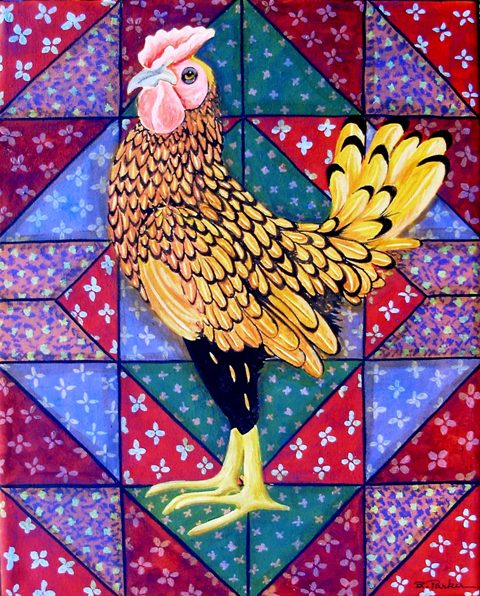
8″ x 10″ Acrylic on Yes! Gallery Wrapped Canvas

I know, I know….. Must be because I’m sick.  I spent more hours than I can count on this.  I spent 4 hours on the Banty, before I ever added the quilt.  Huh???


This second photo is a little truer to the color.  I added a half a dozen blue glazes to the quilt to try to knock it back.

I know…. “What was I thinking?”  ;)


I fell off into a folk art mode.  I really must shake this cold.  It’s messing with my head.  hahaha  :D

George Washington Carver
  • Born: c. 1860
  • Birthplace: Diamond Grove, Missouri
  • Died: 5 January 1943
  • Best Known As: America’s great peanut innovator
George Washington Carver was a celebrated botanist and inventor at a time when it was still rare for African-Americans to reach those heights. The son of a Missouri slave, Carver grew up to attend Iowa State University, earning a bachelor’s degree in 1894 and a master’s in 1896. He then joined the faculty of Booker T. Washington‘s Tuskegee Institute. His attempts to find crop alternatives to cotton led him to the peanut; eventually he created more than 325 products from the humble legume, helping to create demand for the plant and establish it as a major American crop. Carver also worked with sweet potatoes, soybeans and pecans, among other plants, and is often credited with changing the face of agriculture in the American south.

Carver’s exact birthdate is unknown; a Missouri census record from 1870 lists George Carver as 10 years old; a photo of that record can be found here… He was an accomplished artist who displayed paintings at the 1893 Chicago World’s Fair… Carver is often credited with inventing peanut butter, but it seems others had created that product before Carver began his work with peanuts… He is no relation to President George Washington. According to the Wikipedia, Carver began to use the name George Washington Carver at Iowa State “to avoid confusion with another George Carver in his classes”… Carver was posthumously awarded the degree of Doctor of Humane Letters by Iowa State in 1994… Another brilliant botanist of the same era was Luther Burbank.