- Thomas H. Huxley, 1825-1895

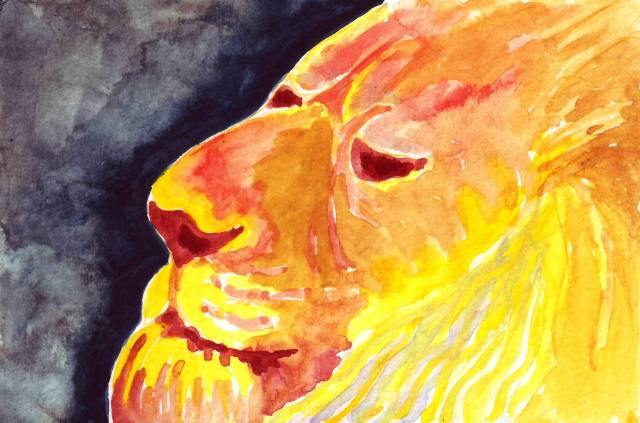
The Shy Lion
4″ x 6″ Watercolor
We have been invited to a challenge over at the Artswebshow blog, to paint or draw this lion. I painted this one first and thought he looked kinda sweet and shy. Then….
The Cowardly Lion
4″ x 6″ Watercolor
I think this one looks like the Cowardly Lion on The Wizard of Oz. I quit while I was ahead. Then….

The Lion in Bethville
4″ x 6″ Watercolor
This one felt more like me. I had a great time doing this. If you want to see a terrific lion, go over to Leslie White’s blog and see hers. It’s amazing! There may be more, but I have been so busy that I haven’t been able to get around and visit my favorite blogs. I’m going to try to make some time, because they always brighten my day!

Thomas H. Huxley
Thomas Henry Huxley PC FRS (4 May 1825 – 29 June 1895) was an English biologist, known as “Darwin’s Bulldog” for his advocacy of Charles Darwin’s theory of evolution.[1]
Huxley’s famous 1860 debate with Samuel Wilberforce was a key moment in the wider acceptance of evolution, and in his own career. Huxley had been planning to leave Oxford on the previous day, but, after an encounter with Robert Chambers, the author of Vestiges, he changed his mind and decided to join the debate. Wilberforce was coached by Richard Owen, against whom Huxley also debated whether humans were closely related to apes. More…..








 Born in Joplin, Missouri, James Langston Hughes was a member of an abolitionist family. He was the great-great-grandson of Charles Henry Langston, brother of John Mercer Langston, who was the first Black American to be elected to public office, in 1855. Hughes attended Central High School in Cleveland, Ohio, but began writing poetry in the eighth grade, and was selected as Class Poet. His father didn’t think he would be able to make a living at writing, and encouraged him to pursue a more practical career. He paid his son’s tuition to Columbia University on the grounds he study engineering. After a short time, Langston dropped out of the program with a B+ average; all the while he continued writing poetry. His first published poem was also one of his most famous, “The Negro Speaks of Rivers”, and it appeared in Brownie’s Book. Later, his poems, short plays, essays and short stories appeared in the NAACP publication Crisis Magazine and in Opportunity Magazine and other publications.